

Fog Screen Machines for Immersive Projection
Turn water mist into a walk-through projection surface for exhibitions, museums, and live events.
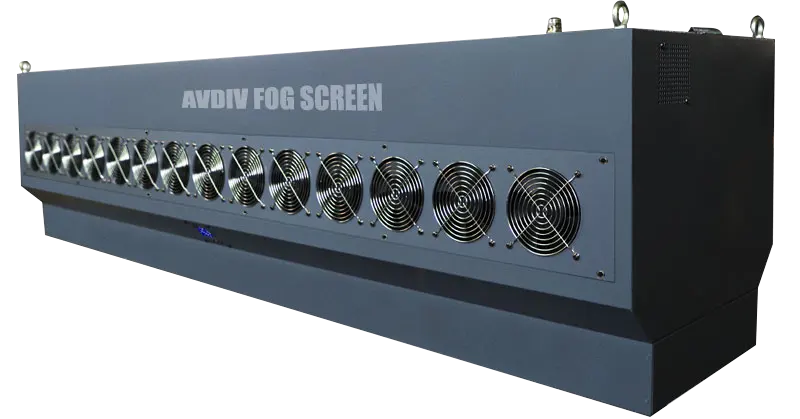
AVDIV FC Series
Choose from four machine widths to suit your venue and installation.
FC-100 · FC-200 · FC-250 · FC-300
How Fog Screen Projection Works
An AVDIV fog screen machine uses ultrasonic atomizers to produce fine water mist. Controlled airflow shapes the mist into a thin curtain, and a projector displays images or video on its surface. Visitors can walk through the curtain, making it suitable for immersive entrances and interactive installations.
Fog Screen Applications
Exhibitions & Trade Shows
Create a walk-through entrance or project a brand reveal onto a curtain of mist.
Museums & Visitor Attractions
Use mist projection to introduce a gallery, mark a transition, or add a visual element to an exhibit.
Live Events & Entertainment
Project logos and moving visuals onto mist for entrances, performances, and special events.
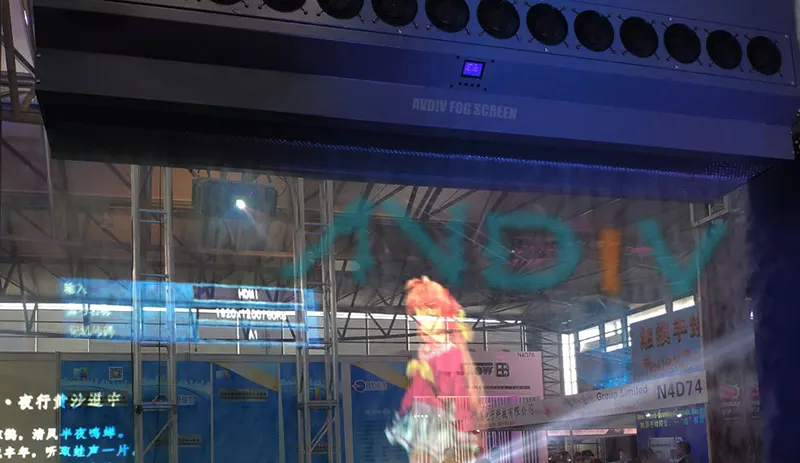
See the Fog Screen in Action
See how projected images appear on a curtain of fine water mist in a real exhibition setting.
Choosing the Right FC Series Model
The FC Series comes in four standard widths, from 1 to 3 m. The model you need depends mainly on the width of the opening or entrance you want to cover, and on how the machine will be mounted. The FC-100 is the smallest machine, 100 cm wide, for narrow entrances and small booths. The FC-200 and FC-250 cover mid-size openings of 2 and 2.5 m. The FC-300, at 3 m wide, is for large entrances and stage-width installations where a single machine has to carry the whole image. Width is not the only difference. Water consumption runs from 8–10 L/h on the FC-100 to 12–15 L/h on the FC-300, and gross weight from 80 kg to 180 kg, so the larger models also need more water supply and stronger rigging. The full figures are in the FC Series comparison table and the machine dimensions refer to the machine body — ask for the current model datasheet when you plan clearances, electrical supply, or rigging. If your opening is wider than 3 m, or you need a non-standard width, tell us the overall span you want to cover. Multiple units and custom widths can be discussed as part of the quote.
What to Plan Before You Order
A fog screen installation is planned around the venue, not just the machine. Four things decide whether the effect works well. First, the space: the available installation width and the mounting height. Second, water: confirm which water supply arrangement applies to your machine and where water can be drained after use. Tank run time depends on the model, the usable water volume, and operating conditions. Third, the projector: allow space for the projector and clear sightlines, and check the planned image size during the venue walkthrough. Fourth, the environment: ambient lighting and nearby airflow both affect how the image reads on the mist, so they should be checked on site rather than assumed. For temporary exhibitions and events, the mounting is usually a truss. See the fog screen truss options and the installation guide for planning details, and have a qualified rigging professional confirm the support structure, rated loads, and mounting hardware for the complete installation.
Fog Screen vs. a Standard Projection Screen
A standard projection screen is a solid surface: the image is sharp and bright, but the audience stays on one side of it. A fog screen is a curtain of fine mist. The image appears where projected light meets the mist, and visitors can walk through it — which is why it is used for entrances, brand reveals, and transitions between spaces rather than for long-form viewing. That walk-through effect is also what makes planning matter. A solid screen works in almost any room; a mist curtain needs controlled airflow and a check on ambient light, and the projector position has to suit the venue. For the right setting — a darkened entrance, a museum transition, a stage reveal — the fog screen does something a flat screen cannot. For a bright room where the audience sits and watches for an hour, a standard screen is the better choice.
How to Request a Quote
Tell us your venue type, the available installation width, and the delivery country or city. If you already know which FC Series model you want, include it; if not, tell us the width you need to cover and your project date, and we will recommend a model. A venue drawing or photo helps clarify the layout, especially for truss-mounted or multi-unit installations. Request a Quote — see the fog screen demos first if you want to check the visual effect before deciding.
Latest from the Blog
Guides and planning notes on fog screen machines.
- Fog Screen for Exhibitions: Planning Guide
- Fog Screen Price Guide: How Much Does a Fog Screen Machine Cost?
- How Does a Fog Screen Work?
Tell us your venue type, available installation width, and delivery country so we can help you choose a suitable FC Series model.